
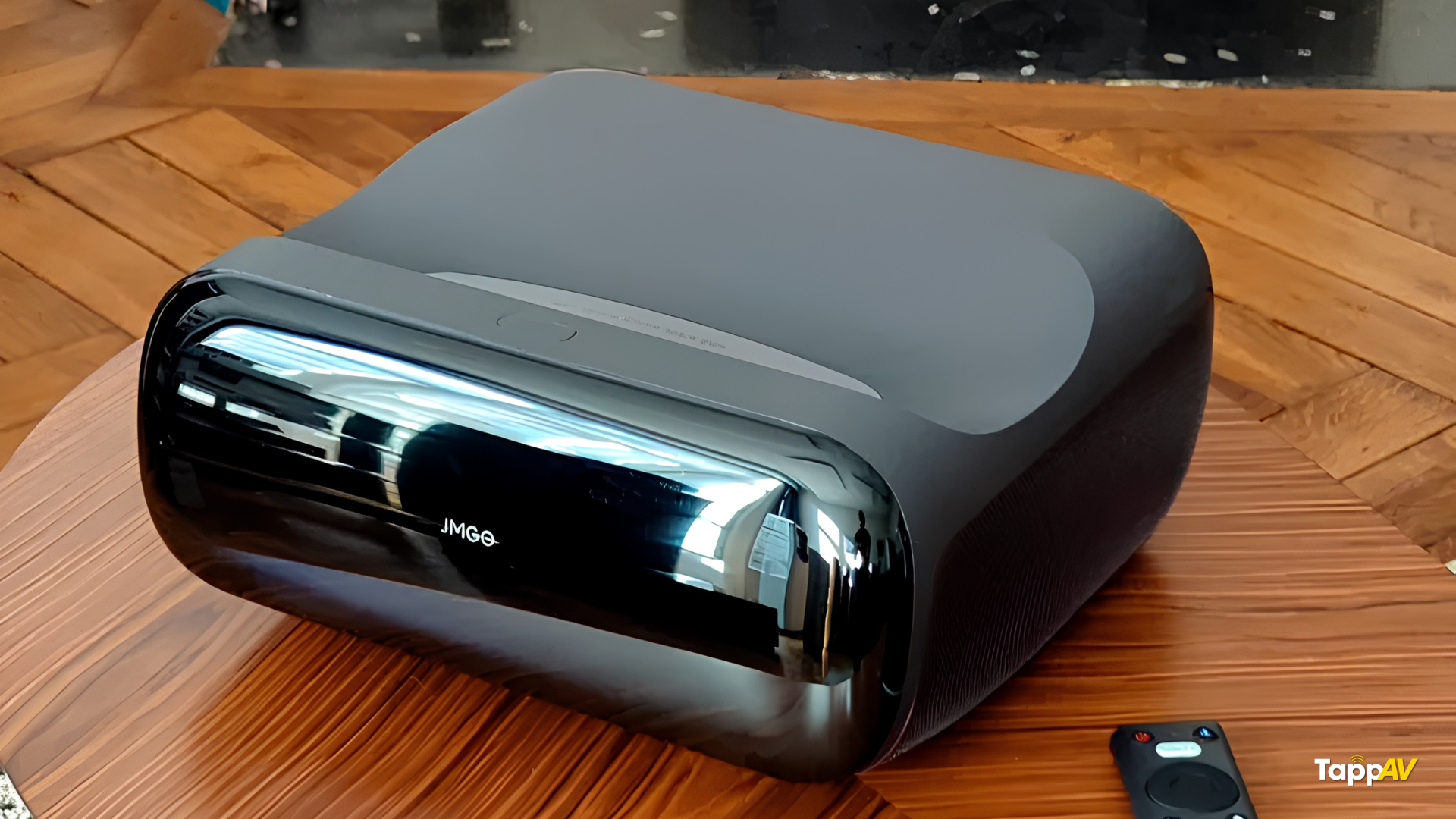
Ever since we posted our hands-on video on the JMGO O2S Ultra, one question has flooded our comments "How does this actually compare to the XGIMI Horizon 20 Max?"
Fair question. Both are 2025-26 flagship-tier laser projectors. Both use triple-laser RGB engines. Both run Google TV. On a spec sheet, they can look almost interchangeable.
They are not.
📺 Watch our full hands-on review here:
This isn't a spec-sheet regurgitation. This is what we actually found when we set the O2S Ultra up in our own demo space and ran it against real Indian living-room lighting conditions.
And since you've asked for it so consistently, we're not burying the answer at the bottom either, jump straight to the XGIMI Horizon 20 Max vs JMGO O2S Ultra comparison if that's what brought you here, or read on for the full picture first.
The Problem the O2S Ultra Was Actually Built to Solve
Every Ultra Short Throw projector claims to be "space-saving." Most aren't, really, a 0.25:1 throw ratio still needs 10-15 inches of clearance from the wall, which in a lot of Indian TV units means either a custom-built console or an awkward compromise where furniture gets pulled forward.
JMGO didn't just shave a few centimetres off that number. They engineered a 0.16:1 throw ratio, tight enough to throw a full 100-inch image from just 16.8cm (6.6 inches) off the wall. That's the kind of clearance a standard, off the shelf TV unit already has. No carpentry required.
This is the single biggest reason we think this projector deserves its own conversation, separate from every other "compact UST" claim you've heard before.

Unboxing Reality Check: It's Genuinely Smaller Than It Looks in Photos
At 312 x 290 x 140mm and about 4.5kg, this is one of those products where photos don't do the scale justice. Reviewers and buyers alike keep comparing it to a bread maker or a large toaster, and honestly, that's accurate. Most bright UST projectors in this performance class are noticeably bulkier, often nearing 12kg. The O2S Ultra is light enough to genuinely move between rooms without a two-person job.

What's Actually Driving the Picture: MALC™ 3.0
JMGO's proprietary MALC (Multi-layer Active Laser Control) 3.0 engine uses three discrete lasers, Red, Green, and Blue, rather than a single laser bounced through a spinning colour wheel. This is the same fundamental approach premium laser TVs use to avoid the washed-out, slightly-off colour rendering that cheaper single-laser projectors are known for.
On paper, this delivers:
- 110% coverage of the BT.2020 colour gamut, wider than the DCI-P3 standard used in commercial cinema screens
- Colour accuracy rated at ΔE below 1, genuinely excellent factory calibration
- 3,600 ISO lumens of brightness
- A quoted dynamic contrast figure in the millions-to-one range (a marketing number, the practical, native contrast on this class of DLP chip sits meaningfully lower, but still very strong for the format)
What that translates to in a room: deep, believable blacks without losing shadow detail, and colour that doesn't need aggressive calibration to look right out of the box.
Living With It: Setup, Daylight, and the Small Print
UST projectors have a reputation for being fussy, move them a few millimetres and the image geometry can shift noticeably. JMGO addresses this with onboard CMOS cameras and Time-of-Flight sensors that continuously auto-correct keystone and focus, and adapt brightness to ambient light in real time.
In practice, here's what actually matters for an Indian living room:
Where it excels:
- Sharp, precise 4K detail, text and fine textures stay crisp right into the corners
- Very natural skin tones and colour reproduction, even in high-contrast scenes
- Smooth motion handling on pans and fast camera movement, no visible judder
- Minimal rainbow effect (the classic DLP weakness), only occasionally visible on high-contrast edges
- Genuinely usable with curtains open, not just in a blacked-out room

Where you need to manage expectations:
- A faint vignetting can show up in the corners against very light backgrounds, subtle, but worth knowing about
- Full daylight, direct-sun-on-the-wall conditions still call for pairing it with an ALR (Ambient Light Rejecting) screen, this is standard practice for any UST projector, not a flaw unique to this one
- Out-of-the-box colour temperature can lean slightly cool before a quick calibration pass
Google TV, Sorted Sound, and Everyday Usability
The O2S Ultra ships with Google TV 5.0, powered by a MediaTek MT9679 chipset with 4GB RAM and 64GB storage, and comes with certified native Netflix support plus Disney+, Prime Video, and YouTube 4K built in, no extra streaming stick required. Google Assistant voice control handles playback, volume, and smart home commands hands-free.
Audio comes from a Dynaudio-tuned 20W system (2x10W) supporting Dolby Audio and DTS-HD, genuinely capable for every day, casual viewing. As always, our stance at TappAV stays the same: great built-in audio is a bonus, not a replacement for a properly designed AVR + speaker layout if you're building a dedicated media room.
For gaming, PS5 and casual console play feels smooth thanks to solid motion handling, though competitive gamers chasing the lowest possible input lag will still want a dedicated gaming-first setup.

The Comparison Everyone's Been Asking For: XGIMI Horizon 20 Max vs JMGO O2S Ultra
Alright, TappRoom , here's the breakdown you've been waiting for.
These two projectors solve different problems, even though they compete on paper. Getting this right matters more than any single spec.
|
XGIMI Horizon 20 Max |
JMGO O2S Ultra |
|
|
Category |
Lifestyle short-throw projector (needs distance/ceiling or shelf placement) |
Ultra Short Throw "Laser TV" (sits flush against the wall) |
|
Throw Ratio |
1.2–1.5:1 (needs several feet of distance) |
0.16:1 (sits just 6.6" from the wall) |
|
Brightness |
5,700 ISO Lumens |
3,600 ISO Lumens |
|
Colour Gamut |
110% BT.2020 |
110% BT.2020 |
|
Placement Flexibility |
Motorized lens shift + zoom , can sit almost anywhere in the room |
Must sit directly against/near the wall it projects on |
|
Best Screen Distance Use Case |
Rooms where the projector sits on a shelf, console, or ceiling mount at a distance |
Rooms with no space for a projector at distance , needs only console depth |
|
Ideal Room Type |
Larger living rooms, media rooms, flexible placement setups |
Compact apartments, rooms where a "shoebox on a shelf" isn't viable |
|
Sound |
Harman Kardon, 24W |
Dynaudio, 20W |
|
Gaming |
Lower input lag, better suited to serious gaming |
Smooth for casual gaming, not built for competitive response times |
|
Price |
~$2,999 |
~$2,299–$2,999 (region/bundle dependent) |
So which one should you actually buy?
Pick the XGIMI Horizon 20 Max if: your room has genuine ambient light to fight , big windows, no curtains, an open-plan living space , and you have the physical room to place a projector at a normal throw distance. Its higher brightness and motorized lens flexibility make it the better all-rounder for larger, brighter rooms.
Pick the JMGO O2S Ultra if: your biggest obstacle is space, not sunlight. If you're in a compact apartment, don't have anywhere to mount or shelf a projector at distance, and want something that behaves like a TV replacement rather than a "projector installation" , the O2S Ultra's 0.16:1 throw ratio solves a problem the Horizon 20 Max simply isn't designed to solve.
The honest nuance our TappRoom community keeps missing: these aren't really rivals fighting for the same buyer. One is a flexible-placement lifestyle projector. The other is a TV replacement disguised as a projector. The right question isn't "which is better" , it's "which problem does my room actually have?"
Our Verdict
The JMGO O2S Ultra isn't trying to out-brighten every projector on the market , it's solving the one problem that stops most Indian homeowners from even considering a projector in the first place: space. For compact apartments, rental homes, or anyone who wants a "just place it and forget it" experience, this is currently one of the smartest Laser TVs available.
Still not sure whether your room calls for a lifestyle projector, a UST Laser TV, or a full dedicated theater build? That's exactly the kind of room-specific call our team makes every day. Reach out and let's figure out what actually fits your space , not just what's trending in the comments.
Quick Spec Snapshot
|
Spec |
Detail |
|
Brightness |
3,600 ISO Lumens (MALC 3.0 Triple Laser) |
|
Resolution |
4K UHD (0.47" DLP, XPR pixel-shifted) |
|
Colour Gamut |
110% BT.2020, ΔE < 1 |
|
Throw Ratio |
0.16:1 (100" image from 16.8cm) |
|
Screen Size Range |
80"–150" |
|
Dimensions / Weight |
312 x 290 x 140mm / ~4.5kg |
|
Sound |
Dynaudio, 2x10W, Dolby Audio + DTS-HD |
|
OS |
Google TV 5.0 (native Netflix) |
|
Price |
~$2,299–$2,999 (varies by bundle/region) |
Ready to Design Your Dream Home Theater?
Every room is different, your wall colour, your ceiling height, your budget, the way you actually watch. A great projector is only half the story. The other half is system design done right.
Book a free consultation call with TappAV's experts, and let's design a setup that's built around your space, not a generic spec sheet.
Share:
XGIMI Horizon 20 Max 4K Review: Is This the Brightest Lifestyle Projector Worth Your Living Room?
Sealed vs Ported Subwoofer: Which One Fits Your Home Theater?