
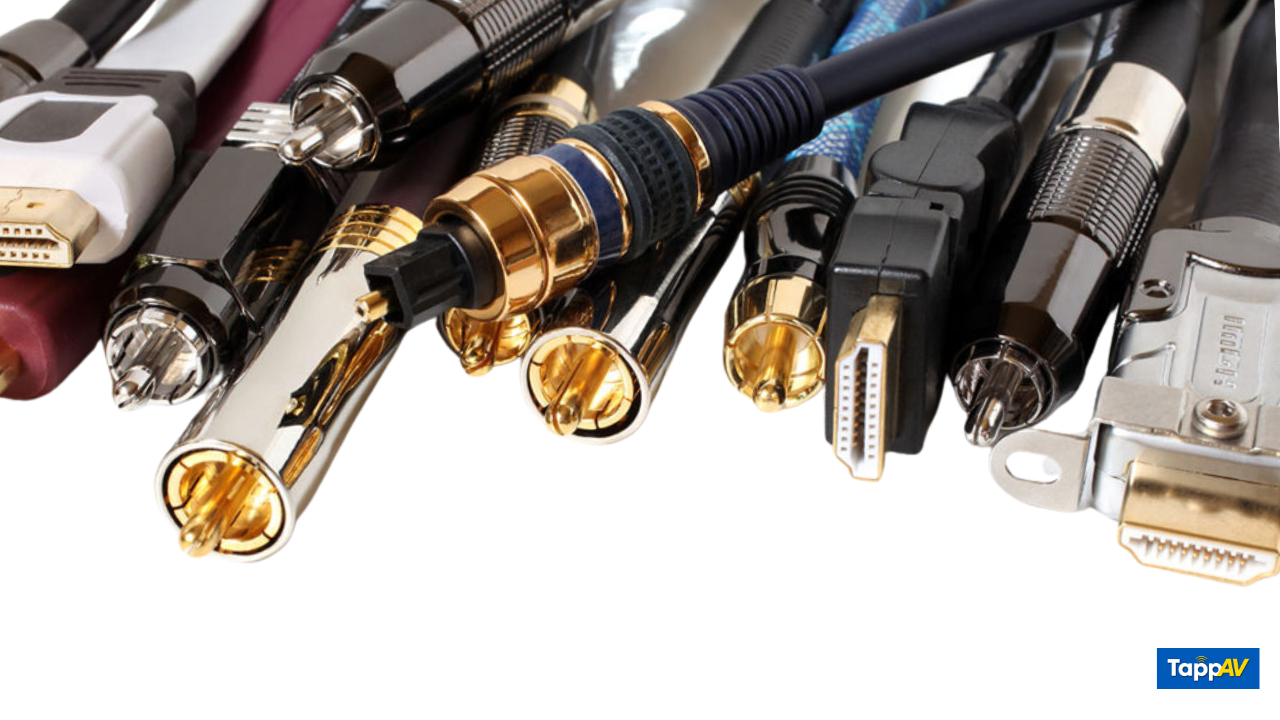
Few topics in hi-fi create more debate than cables.
Some people believe cables can transform a system. Others believe all cable upgrades are snake oil. The truth sits somewhere in the middle, and it is much more practical than the argument usually sounds.
Yes, cables matter. But they matter most when they are chosen correctly for the job, not simply because they are expensive.
What Cables Actually Do
A cable has a simple job: carry a signal from one component to another with as little loss, noise, or interference as possible.
In a hi-fi or home cinema system, cables usually fall into a few categories:
- Speaker cables
- RCA or XLR interconnects
- Subwoofer cables
- HDMI cables
- Optical, coaxial, and network cables
- Power cables

Each type has a different role, and each should be judged differently. A speaker cable is not doing the same job as an HDMI cable. A subwoofer cable running across a room has different concerns from a short interconnect between a DAC and amplifier.
That is where a lot of confusion begins.
Where Cable Quality Genuinely Matters
Cable quality matters when it affects reliability, signal integrity, safety, or system noise.
For speaker cables, the most important things are correct gauge, good copper quality, secure termination, and appropriate length. If the cable is too thin for a long run, it can increase resistance and reduce amplifier control. This can slightly affect dynamics, bass grip, and overall consistency.
For long speaker runs, especially in home cinema rooms, cable thickness matters more than brand prestige. A well-made 12 AWG or 14 AWG cable is often more meaningful than a very expensive but undersized cable.
For interconnects, shielding matters. Poorly shielded RCA cables can pick up hum or noise, especially when placed near power cables, dimmers, routers, or AV racks with many components.
For subwoofers, cable quality can matter because the cable may be long and may pass near electrical wiring. A properly shielded subwoofer cable can help reduce hum and interference.
For HDMI, certification matters more than luxury branding. If you are running 4K/120, 8K, HDR, Dolby Vision, or long-distance HDMI, use a certified high-speed or ultra high-speed HDMI cable. For longer runs, active optical HDMI is often the safer choice.
Where Expensive Cables Are Often Overrated?
Expensive cables are often overrated when they promise dramatic transformation in a system that already has correctly specified cables.
If the cable is already the right gauge, properly shielded, well terminated, and suitable for the required signal, spending many times more may bring very small improvements, if any.
This is especially true in home cinema. In a cinema room, speaker placement, subwoofer integration, room correction, acoustic treatment, and calibration will almost always make a much bigger difference than exotic cable upgrades.
In a two-channel hi-fi system, cable differences can be more noticeable, especially with highly revealing speakers and electronics. But even there, cables should be treated as fine-tuning, not the foundation of the system.
The foundation is still:
- Speaker quality
- Amplifier matching
- Source quality
- Room acoustics
- Speaker placement
- Power and grounding quality
- Proper setup and calibration
Cables come after these basics are done properly. I see many people making this mistake of concentrating on high end cables but not prioritising on the above factors.
Speaker Cables: What to Choose
For most hi-fi and home cinema systems, choose good-quality oxygen-free copper speaker cable with the correct thickness.
As a practical guide for high end setups:
- Short runs up to around 15 meters (<300Watts): 14 AWG is usually fine
- Longer runs or demanding speakers (300-400Watts>): 12 AWG is safer
- Very long in-wall runs: use properly rated conduit in-wall cable, often 14 or 12 AWG
Avoid very thin cable for serious speakers. Also avoid poorly made connectors that become loose over time. A secure banana plug, spade, or properly clamped bare wire connection is more important than fancy packaging.

For in-wall installations, always use cable rated for in-wall use. This is not just about sound. It is about safety and compliance. And don't forget wiring can happen only once so make your infra prepared for long term changes or upgrades.
RCA and XLR Cables: Shielding and System Matching

RCA cables are unbalanced, so they are more sensitive to noise and grounding issues. Good shielding is useful, especially in AV racks where many power and signal cables run together. This is extremely crucial as lot of hissing sound becomes more evident when the cinema goes silent.
XLR cables are balanced and generally better for longer runs. If your processor, DAC, preamp, or power amplifier supports balanced connections, XLR can be useful, particularly in larger systems.
But again, the expensive option is not automatically the better option. A well-made professional-grade XLR cable can perform extremely well. We use Amphenol, Kordz, Neutrik and Impression connectors for our interconnects and they have served us very well.
HDMI Cables: Do Not Gamble
HDMI is different from analog audio cables. This cable can be the reason for highest number of service complaints in the products as these cables carry digital information along with Power Signal and is prone to quick damages due to surges.

Also, with HDMI, the signal either works properly or it creates visible and audible problems: dropouts, flickering, black screens, handshake issues, no HDR, or no 4K/120 support.
For modern home cinema, we use certified cables:
- Premium High Speed HDMI for 4K/60
- Ultra High Speed HDMI for 4K/120, 8K, VRR, and high-bandwidth gaming
- Active optical HDMI for long projector runs
This is one area where cheap, uncertified cables can cause real headaches. But that does not mean you need an extremely expensive HDMI cable. You need the right specification, proper length, and reliable construction.
Many people who are now opting for Smart Projectors and pulling out eARC from it to the sound system should be all the more careful as not every Active Optical long run HDMI cable supports eARC or ARC. Wrong cables here can cause audio lag issues, audio dropouts and definitely an unpleasurable home cinema experience.

The cables we recommend/use at TappAV goes through rigorous testing under multiple scenarios like -
1. Dual HDMI Out AV Receivers
2. Modern Day TVs with eARC
3. Portable Projectors ARC/eARC
4. UST Projectors ARC/eARC
5. Apple TV HDMI 2.1 test
We prefer long term resolution by laying two long run HDMI Cables for fail safe measures.
Power Cables: The Most Misunderstood Upgrade
Power cables are probably the most controversial category and should ideally require a separate blog article. But let's try to cover the basics.
Do they matter? Sometimes, yes.
Will they transform every system? No.
A well-built power cable with proper connectors can improve reliability and may help in systems with noisy power or poor stock cables. But if the room has grounding problems, voltage fluctuation, dimmer noise, or poor electrical layout, an expensive power cable will not magically fix the root issue.
For serious systems, the better approach is:
- Dedicated power line where possible
- Correct grounding
- Quality wall sockets
- Proper rack power distribution
- Surge protection
- Power conditioning only where it helps and does not restrict amplifier dynamics
Power cables should be treated as the final polish, not the first upgrade.
The Hi-Fi Perspective: Real Reason for Expensive Cables Existence?
In a two-channel hi-fi system, cables can be used as subtle tuning tools.
A system that sounds too bright may benefit from a smoother interconnect or speaker cable. A system that sounds too soft may benefit from a more open and detailed cable. But the changes are usually smaller than changing speakers, amplifier, cartridge, DAC, or room placement.
This is why cable upgrades should be auditioned carefully. A cable that sounds impressive for five minutes may become fatiguing over time. The right cable should make the system sound more natural, not just more detailed.
A Sensible Budget Rule for All
There is no perfect percentage, but this is a practical guideline that we have been following:
- Entry-level system: keep cables functional and reliable
- Mid-level system: spend enough for good build, shielding, and correct gauge
- High-end system: consider cable matching, but audition before buying
- Home cinema: prioritize infrastructure, gauge, length, certification, and reliability

For most systems, spending around 5-8% of the total system cost on cables and power accessories is more than enough. In many cases, even less is fine if the cables are well chosen.
Planning to Upgrade Cables? Read this first.
The best cable upgrade is the one that solves a problem, fixes a distortion or improves something specific like:
- Reduces hum
- Handles longer distance
- Supports the required video bandwidth
- Improves connection reliability
- Matches amplifier and speaker requirements
- Meets in-wall safety standards
- Gives cleaner rack management
If the cable does not solve a real problem, it should be treated as a luxury tuning choice.
Final Verdict
Do expensive cables matter?
Sometimes. But correctly chosen cables matter much more than expensive cables.
In hi-fi, cables can fine-tune the final sound of a revealing system. In home cinema, cables are mainly about reliability, correct specification, safety, and noise-free performance.
The smartest approach is simple:
Buy good cables. Avoid bad cables. Be careful with overpriced cables. Spend the real money where it changes the experience most: speakers, amplification, room acoustics, subwoofers, setup, and calibration.
Good cables support a great system.
They should not become the system.
Share:
Best TVs 2026: The Definitive Guide for Your Home Theatre in India
XGIMI Horizon 20 Max 4K Review: Is This the Brightest Lifestyle Projector Worth Your Living Room?