
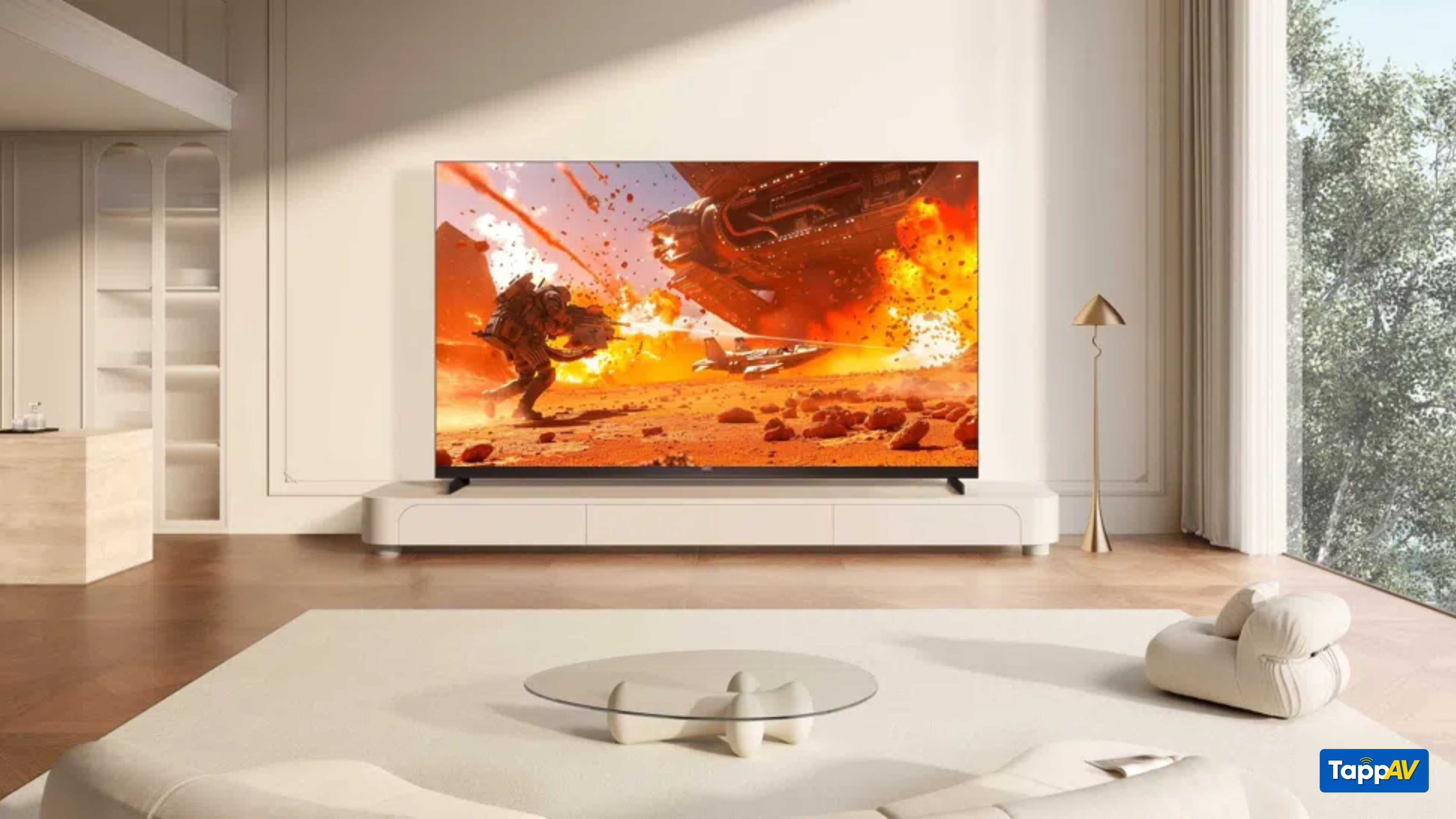
OLED just got brighter than anyone thought possible.
RGB mini-LED has gone from a buzzword to something you can actually buy. And the best TV of 2026 for your home theatre might not be the one everyone online is raving about, because most of those reviews aren't written for Indian living rooms, Indian lighting conditions, or Indian home theatre setups.

Before You Read Any Spec Sheet, Read This
There's a question we ask every client before we recommend a single display:
"What does your room actually look like at 8 PM?"
Because a Samsung QD-OLED in a sunlit open-plan room without blackout blinds is a very different proposition from the same panel in a light-controlled home theatre. And a 4,000-nit RGB mini-LED TV in a dark room with an incorrectly calibrated signal chain isn't going to give you the experience you're paying for.
The 2026 television landscape has more genuinely credible options than any year we can remember. OLED is brighter than ever. RGB mini-LED has arrived in force, multiple brands, multiple price points. And the mid-range has become extraordinary value.
But the right TV is still only one node in a system. It's the output device for your Dolby Atmos signal chain, your streaming sources, your Dirac-calibrated amplification. A great panel deserves a great system around it. That's the context for everything that follows.
The 2026 Technology Landscape at a Glance
Two panel technologies are dominating 2026, and understanding them changes how you read every spec sheet:
OLED (and QD-OLED)
Self-emissive pixels deliver true black, infinite contrast, and precise per-pixel control. The weakness has always been peak brightness.
In 2026, that weakness has shrunk dramatically. Samsung's QD-OLED now exceeds 2,500 nits peak.
The trade-off: OLEDs still don't love very bright rooms, and the 83-inch+ segment hasn't fully converted to the better panel technology yet.
RGB mini-LED
The new challenger. Instead of the white LEDs used in conventional mini-LED, RGB mini-LED uses dedicated red, green and blue light sources, the same philosophy that makes cinema-grade reference monitors so accurate. This delivers measurably better colour purity, higher peak brightness, and in some implementations, fullscreen brightness that dwarfs any OLED. Sony, Hisense, TCL, Samsung, and LG all launched RGB mini-LED panels in 2026. Each has a different implementation. The differences matter.
Our 2026 TV Picks - What's Worth Your Attention
🏆 Best Flagship OLED: Samsung S95H (QD-OLED)
The one-line verdict: The brightest OLED ever made. Nothing else comes close on peak output.
The Samsung S95H has done something reviewers have been waiting years for: it's made QD-OLED bright enough to genuinely challenge mini-LED in a living room setting. Independent lab testing recorded 2,553 nits peak brightness, a number that was firmly in the mini-LED domain just 18 months ago, alongside near-perfect DCI-P3 colour coverage and an anti-reflection coating that transforms daytime viewing.
The redesigned chassis is cleaner, eliminating the external One Connect box that many clients found cumbersome to route. Four full HDMI 2.1 ports, native 165Hz, and a 70W 4.2.2 Dolby Atmos speaker system make this a serious all-rounder even before you add a dedicated audio system.

The honest caveat: Samsung still does not support Dolby Vision. If your library leans heavily on Apple TV+, Disney+, or iTunes purchases, all of which rely primarily on Dolby Vision for their best HDR quality, that remains a meaningful gap.
For clients running dedicated 4K Blu-ray or HDR10+/HDR10-primary streaming, it's largely a non-issue.
Best for: Dark or moderately lit home theatres; clients who prioritise colour accuracy and peak HDR performance; gaming setups.
Approximate India pricing (65"): ₹3,20,000 – ₹3,80,000 (import/parallel; official Samsung India pricing to be confirmed for the H-series refresh).
✅ Best OLED for Most Buyers: LG C6
The one-line verdict: The most carefully tuned TV of 2026. The one we'd put in most homes.
The LG C6 is what happens when a company resists the temptation to chase every spec record and instead focuses on getting everything right. What Hi-Fi? called it "simply superb"; high praise given that they simultaneously found its brighter sibling, the G6, to be over-tuned at the cost of colour accuracy.
In a head-to-head against the Sony Bravia 8, the C6 won on both picture quality and gaming performance. RTINGS recently elevated it to the top of their "Best Upper Mid-Range TV" ranking.
For a dedicated home theatre with good light control, or a living room with quality curtaining or blinds, the C6 delivers the OLED experience at its most complete: the Alpha 11 Gen3 processor, four HDMI 2.1 ports, full Dolby Vision and Dolby Atmos support, a 5-year panel warranty, and webOS 26 with Google and Microsoft AI integration.

The honest caveat: In a very bright room with no light control, the G6's raw brightness advantage starts to tell. If that's your setup, read on.
Best for: Dedicated home theatres; rooms with good light management; film and streaming-focused households; the client who wants one TV to do everything well.
Approximate India pricing (65"): ₹2,40,000–₹2,80,000 (LG India C6 series; street pricing typically drops 10–15% post-launch).
☀️ Best OLED for Bright Rooms: LG G6
The one-line verdict: The OLED that finally answers the brightness complaint at a trade-off.
The LG G6 is LG's answer to the accusation that OLED can't cut it in bright living rooms. Its Brightness Booster Ultra system delivers up to 3.9× the peak brightness of conventional OLED, making it the brightest WOLED panel LG has ever produced.
In a sunny drawing room in the afternoon, the G6 wins arguments that the C6 loses.
But independent reviewers including What Hi-Fi?, who notably didn't award it a full five-star rating, flagged a measurable compromise in colour accuracy compared with the C6. For dark-room cinephiles who prize tonal faithfulness above raw luminance, the C6 is the better-tuned instrument. For sports, bright-room viewing, and anyone who simply can't or won't add blackout blinds to their space, the G6's headline numbers are compelling.

Its Flush Fit Gallery design, sitting virtually flush against the wall, makes it particularly interesting for architecturally integrated installations.
Best for: Bright living rooms without light control; sports and daytime viewing; clean wall-integrated installations.
Approximate India pricing (65"): ₹3,40,000 – ₹4,00,000.
🎨 Best RGB Mini-LED (Accuracy): Sony Bravia 9 II
The one-line verdict: Sony's most confident launch in years. The most cinema-accurate TV of 2026.
Sony's entry into RGB mini-LED makes a bold claim: True RGB.
Every primary colour is generated by dedicated red, green, and blue LEDs; no hybrid compromises, no white-LED backlight. At its London launch, Sony demonstrated it side-by-side with their HX3110 professional studio reference monitor. That's not a marketing stunt. That's a company saying: this is calibration-grade.
Early measurements back that positioning up: approximately 3,990 nits in a 10% HDR window and 827 nits fullscreen, roughly double the fullscreen brightness of the comparably priced LG G6. Sony's Black Screen Pro anti-reflection coating slots between LG's glossy treatment and Samsung's matte finish, handling ambient light without killing black depth.
For clients building a reference-grade home theatre, the Acoustic Multi-Audio+ system with upfiring drivers and the Direct Connect wireless rear speaker integration means the Bravia 9 II is a serious consideration even before the outboard audio system goes in.

The honest caveat for gamers: Sony persists with only two HDMI 2.1 ports out of four, which is a frustrating decision in a year when every serious gaming setup runs multiple high-bandwidth sources. This matters less in a dedicated cinema room than in a multi-use lounge.
Best for: Reference home theatres; colour-critical setups; clients who want the closest thing to a studio monitor in their living room.
Approximate India pricing (65"): ₹3,80,000 – ₹4,50,000 (Sony India pricing subject to Bravia Inc joint venture launch schedule).
💥 Best RGB Mini-LED (Brightness): Hisense UR9
The one-line verdict: 5,000 nits, Devialet-tuned audio, and the most aggressive value play in RGB mini-LED.
Hisense has been building toward this moment for three years. The UR9 lands as the value argument in the RGB mini-LED conversation, meaningfully cheaper than the Sony Bravia 9 II or the Samsung Micro RGB, while delivering 5,000 nits peak brightness, a native 180Hz panel, and a 4.1.2-channel speaker system tuned by Devialet (yes, that Devialet).
The Obsidian Panel anti-reflection treatment holds up well in direct side-by-side viewing. Where the UR9 trades against the Sony is in the precise colour purity story; Hisense's implementation is a hybrid approach rather than Sony's pure independent primary structure. For a dark-room cinephile, that difference is audible in the colour rendering. For everyone else, sports, ambient viewing, gaming, anything brightness-led, the UR9 delivers the RGB mini-LED experience at a price that is genuinely accessible.

For those who want to go even further on value: the Hisense UR8 brings RGB mini-LED to 55-inch at the lowest entry price of any RGB panel in the market.
Best for: Bright rooms; sports and live event viewing; clients who want cutting-edge technology without cutting-edge pricing.
Approximate India pricing (65"): ₹2,80,000 – ₹3,20,000 (Hisense India; UR9 pricing to be confirmed for Indian market).
📐 Best Big-Screen RGB Mini-LED: TCL X11L
The one-line verdict: For the 85-inch-and-above home cinema wall, nothing challenges it on specification or value.
If your home theatre brief includes a screen that demands attention in a large room, the TCL X11L enters a category of its own. TCL claims up to 10,000 nits peak brightness via its Halo Control System and up to 20,000 precise dimming zones in the largest sizes. Whether the eye can discern every nit at the peak end is a fair philosophical debate; what isn't debatable is that the X11L delivers a viewing experience unlike anything from a conventional LED or OLED at its sizes.
The X11L runs Google TV, supports Dolby Vision, and includes a native 144Hz panel with Motion Rate 480 motion handling. For clients who want the large-screen home cinema without OLED pricing at scale, TCL's aggressive price-to-spec positioning is worth a serious conversation.

For those considering the step-down: the TCL QM8L at 65-inch is one of the standout value choices in the entire 2026 LED category, offering Dolby Vision and mini-LED performance that punches significantly above its price bracket.
Best for: Large-format dedicated home theatres; rooms where screen size is the design brief; clients who want the full HDR spectacle.
Approximate India pricing (75"): ₹4,00,000 – ₹5,00,000 (TCL India; import pricing applies to top-tier sizes).
🖼️ Best Lifestyle / Art TV: TCL A4000 Pro vs Samsung The Frame Pro
The one-line verdict: Samsung The Frame Pro is still the most polished art TV. TCL A4000 Pro undercuts it significantly.
The art television category has belonged to Samsung's The Frame for years. In 2026, TCL has arrived with a frame-style mini-LED challenger, the A4000 Pro NXTVISION at pricing that makes the Samsung look expensive. Samsung's response is The Frame Pro 2026, with improved picture performance over its predecessor.

The honest framing for this category: these are design-led purchases. RTINGS describes The Frame Pro as "decent overall" and "great for a bright room" but "mediocre for gaming" and "just okay for home theater." If your brief is a TV that disappears into the wall when not in use, both deliver on that promise. If you're also asking it to be your primary home cinema display, the other panels on this list are better choices.
For integrated AV installations where the interior designer has a strong opinion about what the wall looks like, we work with both and we can ensure whichever you choose is correctly calibrated and integrated into your system.
Best for: Living rooms and bedrooms where aesthetics lead; secondary displays in architecturally sensitive spaces.
💡 Best Value Mini-LED: Hisense U-Series
The one-line verdict: The smart purchase for clients who want OLED-level HDR performance without OLED pricing.
The Hisense U6, U7 and U8 Pro lines have reset the benchmark for what mid-range means. Dolby Vision, Quantum Dot colour, Google TV, and genuine mini-LED dimming technology at pricing that would have placed them firmly in the flagship bracket just three years ago. The 2026 U8 more than doubles the local-dimming zones of its predecessor and adds a low-reflection panel coating.
For clients where the home theatre system is the priority and the display is one input into a larger audio investment, the Hisense U-series frees up significant budget for the Dolby Atmos amplification, acoustic treatment, and speaker installation that will define the room experience far more than the marginal picture quality gap between a U8 and a flagship OLED.
Best for: Clients prioritising the overall system over the display alone; secondary rooms; high-value setups where the audio ambition exceeds the display budget.
Approximate India pricing (65"): ₹80,000–₹1,20,000 (Hisense India; varies by sub-model and retailer).
The TappAV System Perspective: What the TV Reviews Don't Tell You
Every review above measures the TV in isolation. The best review labs in the world use controlled conditions, measurement-grade instruments, and standardised content to derive accurate specifications. That's genuinely useful data.
But it's not the same as designing a complete system.
Here's what changes when the panel goes into a real room:
Source matters. A 4K Blu-ray through a correctly configured HDMI signal chain is a fundamentally different signal from the same title through a streaming box with default settings. The best TV in the world can't correct for a compressed signal chain.
Calibration unlocks the investment. A factory-default OLED calibrated with professional instruments, adjusting white balance, colour management, and tone mapping to your specific room delivers a measurably different result. We do this for every installation we complete, not because it's a premium add-on, but because it's the difference between paying for a panel and actually experiencing it.
The audio system defines the room. In a dedicated home theatre, the speakers and Dolby Atmos configuration; not the TV determine 70% of the cinematic experience. The display is the window. The sound is the room you're standing in.
False ceilings and pre-construction prep change what's possible. The clients who get the best results are the ones who planned the conduit runs, recessed AV wall boxes, and acoustic ceiling depth before the false ceiling went up. If you're at that stage of a new build or renovation, a conversation now saves significant compromise later.
Which TV Is Right for Your Home Theatre?
| Your situation | Our recommendation |
|---|---|
| Dedicated dark home theatre, films & 4K Blu-ray | LG C6 or Samsung S95H |
| Bright living room, sports, ambient viewing | LG G6 or Hisense UR9 |
| Reference-grade cinema room | Sony Bravia 9 II |
| Large room, 85"+ screen brief | TCL X11L |
| Interior-design-led space | Samsung The Frame Pro or TCL A4000 Pro |
| System-first budget allocation | Hisense U7 or U8 |
Frequently Asked Questions
Q: Are these TVs available in India in 2026?
Samsung, LG, Sony, Hisense, and TCL all have active Indian distribution. Flagship RGB mini-LED models (UR9, Bravia 9 II, X11L) may arrive in the Indian market on a delayed schedule compared with US, UK and Australian launches.
Pricing in INR is typically confirmed 2 – 4 months after global launch. We track these launches and advise clients on import timing where the India-market wait is significant.
Q: Does the TV brand matter for a Dolby Atmos home theatre setup?
For the display itself, less than you'd think, your AVR or processor decodes Dolby Atmos, and the TV is primarily the picture output device. What matters for AV integration is HDMI 2.1 port count (for 4K@120Hz passthrough), eARC for audio return to your amplification, and whether the TV's processing introduces input lag that conflicts with your gaming or live sports use.
Q: Should I buy now or wait for Indian market launch pricing?
If you're in the pre-construction or renovation phase of a new home, now is exactly the right time to have the conversation, not about the specific panel, but about the infrastructure that determines what you can install later. Conduit runs, false ceiling depth, recessed boxes, and acoustic preparation decisions happen before the walls go up.
Q: How does TappAV recommend and integrate a TV?
We treat the display as one component in a designed system. Our process covers room analysis, signal chain planning, calibration, and acoustic integration, not retail advice. If you're building a home theatre, the TV selection happens in the context of the room design, not before it.
The Bottom Line
2026 is the year the TV market delivered on promises it's been making for half a decade. RGB mini-LED is real, it's varied, and it ranges from the most accurate panel ever put in a consumer living room (Sony Bravia 9 II) to the most accessible entry point into cutting-edge display technology (Hisense UR8). OLED has responded with its brightest generation yet, anchored by an LG C6 that remains the most complete package for most home theatres.
But the TV is the beginning of the conversation, not the end of it.
If you're designing a home theatre, whether that's a dedicated room or a serious living room installation, we'd like to be part of the planning process from the start. That's when the right decisions get made and the right infrastructure gets built.
Ready to design your home theatre system?
Talk to TappAV →
TappAV is India's specialist home theatre and AV integration company. We design, install and calibrate complete AV systems for new constructions and renovations across India.
Sources: StereoNET Best TVs 2026 (updated May 2026); RTINGS annual best-TV rankings; What Hi-Fi? head-to-head reviews; TechRadar measurement previews. India pricing is indicative and based on current import/retail estimates; confirm with authorised distributors before purchase.
Share:
Sony, Samsung, Philips Home Theaters vs. Real Home Cinema Hi-Fi Brands
Do Expensive Cables Really Matter in Hi-Fi or Home Cinema?