
You've Spent Lakhs on Your Home Theatre. The Wiring Will Make or Break It.
A client in Bengaluru called us six months after setting up his home theatre. Spent ₹14 lakhs on the projector, Dolby Atmos speakers, the works. The sound felt muddy. There was a faint hum he couldn't get rid of. Dialogue was unclear unless he cranked the volume.
The culprit? His speaker cables were running parallel to the power lines inside the wall. A ₹200 routing decision was quietly suffocating a ₹14 lakh system.

This is not a rare story. We hear a version of it almost every month.
The Part Nobody Plans
When people design a home theatre, they obsess over equipment. Rightly so, the projector, the screen, the speakers matter enormously.
But here's what gets missed: the equipment is only as good as the infrastructure it runs on.
Wiring is the infrastructure. And unlike your speakers or your projector, you can't upgrade it after the walls are closed.
Three Things That Actually Determine How Your Theatre Performs
1. Power - cleaner than you think you need
Your home theatre shares a building with ACs, geysers, refrigerators. These appliances create electrical noise on your power lines and that noise bleeds into your audio system. Dedicated circuits, proper earthing, and isolated power for your AV equipment aren't luxury choices. They're the baseline for clean sound.
Most people skip this. And trust me It shows!
2. Cable quality and routing - the details that haunt you later
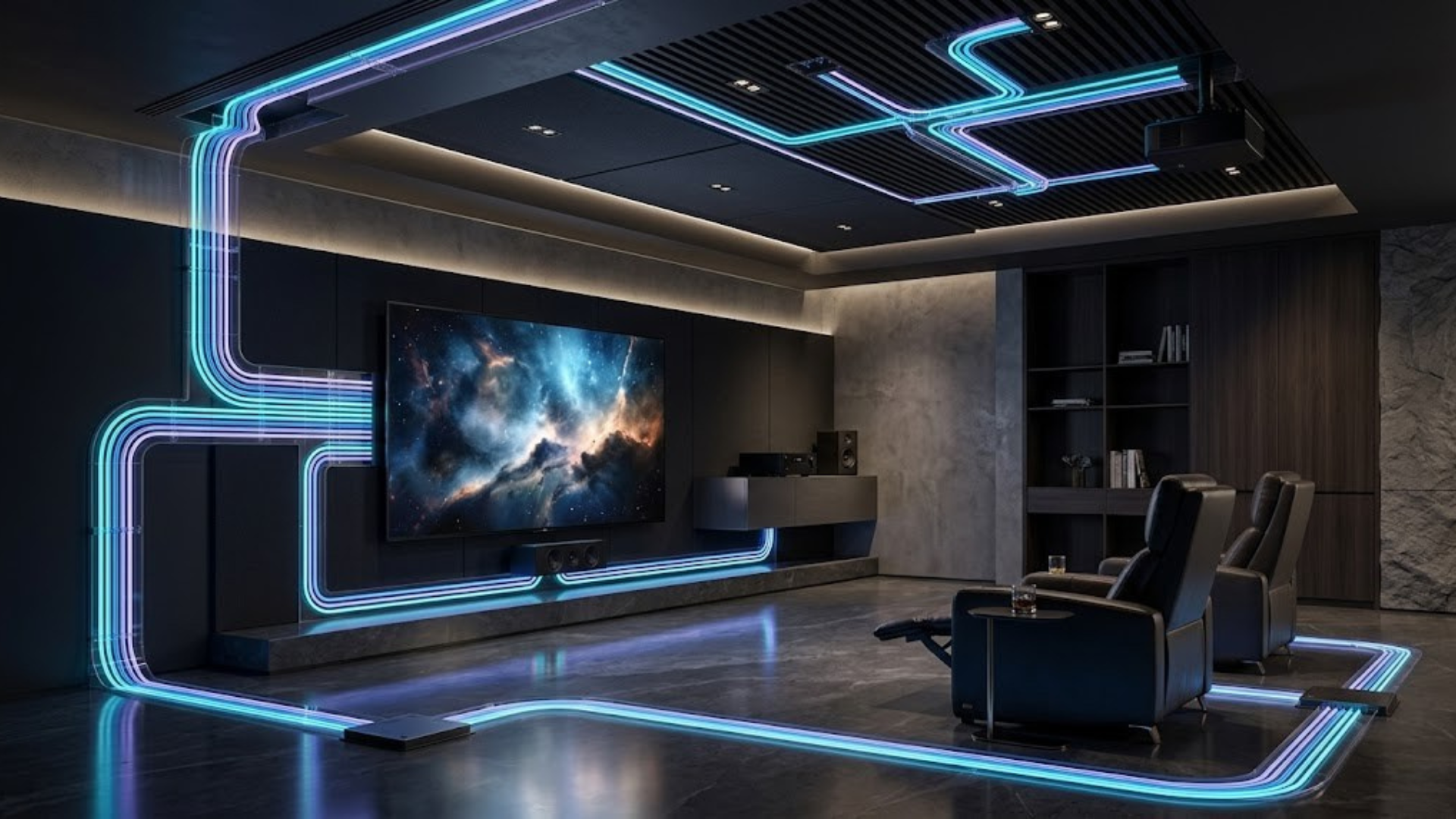
Not all HDMI cables handle 4K at longer lengths. Speaker wire gauge matters more the further it runs. And routing matters enormously, power cables and signal cables running together inside a wall is a noise problem waiting to happen.
The decisions made during construction are nearly impossible to undo cleanly afterward.
3. Network - Wi-Fi isn't good enough
Streaming is half of what most people do in a home theatre today. Wi-Fi is convenient, but it's inconsistent. One wired ethernet cable to your AV rack eliminates buffering, lag, and the maddening drop in quality right when a scene gets intense.
If you're building, run the cable. It costs almost nothing at this stage.
The Mistake That Costs the Most
It isn't choosing the wrong cable brand. It's this: planning the wiring after the interior work is done.
Once the walls are plastered and painted, your options collapse. Fixes require breaking open walls, re-routing conduits, and living with compromises that no amount of equipment can compensate for.
The right time to plan this is before you buy a single speaker, ideally when your architect is still making decisions about wall placements and conduit runs.
What Good Wiring Planning Actually Looks Like
After working on cinema rooms across India, we've distilled the fundamentals into a clear, jargon-free guide: Wiring Essentials for Home Cinema.
It covers power planning, speaker and AV cabling, network infrastructure, cable routing, and how to future-proof the setup for equipment you haven't bought yet. Written so you or your electrician, or your architect, can actually use it without a decoder ring.
👉 [Download the Free Wiring Guide]
Share it with whoever is doing your interiors. It's the kind of document that prevents expensive conversations later.
Need It Done for Your Specific Room?
Every space has its own constraints, room shape, entry points, existing conduits, furniture plans.
If you want a wiring layout designed specifically for your space, something your electrician can follow on-site without guesswork, that's exactly what our 2D Home Theatre Design Service delivers.
The best home theatres we've worked on weren't just well-equipped. They were well-planned, especially in the parts you'll never see.
Build it right the first time.
Share:
Thinking of a Home Theater? Start With These 5 Essentials!
Hisense PX3 Pro Review: Is This the New King of UST Projectors?